
A shareholder may only sublet an apartment with the express approval in writing from the Board of Directors or the Managing Agent, and provided the shareholder has been resident for at least one year. The maximum period of the sublet shall be for one year. Applications to extend the sublet for subsequent periods beyond the initial one year shall be subject to a re-application process and fee. Any shareholder wishing to sublet their unit shall pay the Cooperative a Sublet Fee. That fee shall be the equivalent of one month’s maintenance for the said unit for each period of sublet. (Adopted by a resolution of the Board on 12 September 2005).
Previous Boards : 515 Edgecombe Cooperative
BOARD MEMBERS, 2013–2014
Ms. Cathleen Price [President] Ms. Rebecca Friedman [Vice-President] Ms. Sharon Ruebsteck [Secretary] Dr. Elizabeth Castelli [Treasurer]
Ms. Martha Brophy [Communications]
BOARD MEMBERS, 2012–2013
Dr. Elizabeth Castelli [President] Mr. Bob Drake [Vice-President] Ms. Sharon Ruebsteck [Secretary] Dr. Donald Lee [Treasurer]
Ms. Cathleen Price [Communications]
BOARD MEMBERS, 2011–2012
Dr. Elizabeth Castelli [President] Mr. Bob Drake [Vice-President] Ms. Cathleen Price [Secretary] Mr. Stan DeMagnienville [Treasurer]
Dr. Donald Lee [Communications]
BOARD MEMBERS, 2010–2011 Dr. Elizabeth Castelli (President) Mr. Alex Saavedra (Vice-President) Ms. Cathleen Price (Secretary) Dr. Donald Lee (Treasurer)
Ms. Sandy Dorsey (Communications)
BOARD MEMBERS, 2009–2010
Dr. Donald Lee [President] Dr. Jide Williams [Vice-President] Ms. Lisa Wilson [Secretary] Mr. Andy Hadel [Treasurer]
Dr. Elizabeth Castelli [Communications]
BOARD MEMBERS, 2008–2009
Dr. Donald Lee [President] Dr. Jide Williams [Vice-President] Ms. Lisa Wilson [Secretary] Mr. Andy Hadel [Treasurer]
Dr. Elizabeth Castelli [Communications]
BOARD MEMBERS, 2007–2008 Dr. Donald Lee [President] Dr. Jide Williams [Vice-President] Ms. Lisa Wilson [Secretary] Mr. Andy Hadel [Treasurer]
Dr. Elizabeth Castelli [Communications]
BOARD MEMBERS, 2006–2007 Dr Olajide Williams [President] Dr Donald Lee [Vice President] Mr Andrew Hadel [Treasurer] Ms Lisa Wilson [Secretary]
Mr Ekkerhart Schwarz [Sponsor]
BOARD MEMBERS, 2005–2006 Dr Olajide Williams [President] Mr Neil Nash [Vice President] Dr Donald Lee [Treasurer] Ms Lisa Wilson [Secretary]
Mr Ekkerhart Schwarz [Sponsor]
BOARD MEMBERS, 2004–2005 Dr Olajide Williams [President] Mr Neil Nash [Vice-President] Dr Donald Lee [Treasurer] Ms Stacey Morris [Secretary]
Mr Ekkerhart Schwarz [Sponsor]
Contacts : 515 Edgecombe Cooperative
WHOM TO CONTACT AND WHEN
- MEDICAL OR LIFE-THREATENING SITUATIONS
CALL 911
For other emergencies and problems with the building or your apartment the
first person to contact is:
Building Porter, Mr Lazaro Viltres (917) 731‑6125
Failing this, please contact the following persons in the following order:
Managing Agent Mr Jerry Edelman (212) 721‑0424

Contact a Member of the Board.
Please email complaints to the following address: 311@edgecombe.us
admin : 515 Edgecombe Cooperative
 Smoking in public spaces in the building is not permitted for anyone, including shareholders: it creates a health and fire hazard; it causes a nuisance for people who are trying to climb the stairs; and it poses an extraordinary challenge to our effort to keep the public areas decently clean.
If you do not permit people to smoke within the confines of your apartment, then please understand that you need to ensure that they go all the way outside of the building before they light up. You cannot smoke in the stairwell, nor can your guests or visitors. And you cannot leave your cigarette butts on the stairs.
Please note the relevant House Rule:
“16. (d) No one may smoke in the public halls, stairways, elevators, laundry rooms or other Public Spaces of the Building”
The 100 year old Washington Heights Library finally reopened on Monday, 3 March 2014 after a four years $12.4 million renovation and new technology, including 65 computers and touch screens for public programs.
The 17,000-square-foot library now has an airier design, with new furniture, elevators and wheelchair lifts. The library also features 24 Apple iMacs – only the third in the system to feature Apple computers.
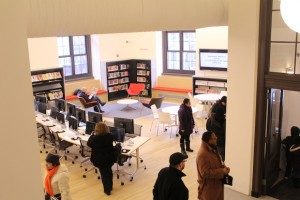
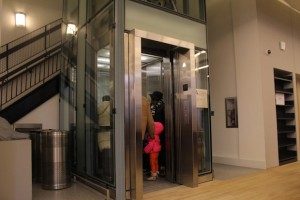
Washington Heights Library 1000 St. Nicholas Avenue (at W. 160th St.) New York, NY 10032–5202
(212) 923‑6054
Library Manager: Vianela Rivas
| Monday | Tuesday | Wednesday | Thursday | Friday | Saturday | Sunday |
|---|---|---|---|---|---|---|
| 11:00 AM – 7:00 PM |
11:00 AM – 6:00 PM |
11:00 AM – 7:00 PM |
11:00 AM – 6:00 PM |
10:00 AM – 5:00 PM |
10:00 AM – 5:00 PM |
CLOSED |
515 Edgecombe Cooperative
[This post is based on the article by grownyc.org]
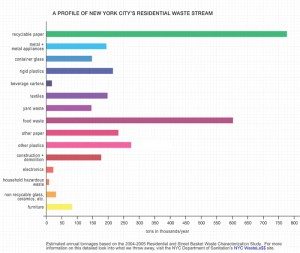
Around 40% of NYC’s waste can be recycled through the curbside recycling program.
Recyclable Paper
Nearly a quarter of NYC’s waste is recyclable paper! Be sure to recycle all clean paper. Reduce your carbon footprint further by taking your name off of mass mailing lists, reducing catalog waste, opting out of offers for credit cards and insurance and stopping unwanted telephone books–learn how at NYCWasteLess.
Metal & Metal Appliances
Recycle cans, clean aluminum foil and “mostly metal” household items with at least 50% metal content. Bulky metal such as shelves and appliances should be placed next to your recycling bins or bags on recycling day (call 311 first for appliances that require CFC removal such as air conditioners and refrigerators). Conserve even more resources by donating reusable metal items. For example, bikes and bike parts can be used by Recycle a Bicycle or Time’s UP! to get more New Yorkers on two wheels.
Container Glass
Unbroken bottles and jars are recyclable through NYC’s curbside recycling program. Empty and rinse containers and remove, then recycle, metal caps and lids. Recycle natural corks with Cork Reharvest using bins located at Whole Foods markets in NYC.
Rigid Plastics
As of April 23, 2013, New Yorkers can recycle all rigid plastics, including yogurt cups, plastic toys, salad containers, shampoo bottles, plastic furniture and plastic appliances. Learn more.
Beverage Cartons
Gable-top and aseptic containers (think O.J., milk, soy milk and boxes of soup stock) are included in the City’s recycling program. Rinse and place with your glass, metal and plastic recyclables.
Textiles
Materials such as old clothing and linens represent almost 6% of NYC’s waste. Recycle your unwanted textiles at one of GrowNYC’s weekly textile collections at select Greenmarkets. Large apartment buildings can sign up for an in-building program through Wearable Collections or RefashioNYC. If your running shoes are worn completely, you can also recycle them through the Reuse-a-Shoe program, which makes them into athletic surfaces.
Yard Waste
4% of the residential waste in our concrete jungle actually comes from yards and green spaces. If you’re lucky enough to have a patch of grass, leave it on the lawn after mowing. Collect fall leaves for compost and be sure to contact the Parks Department for proper removal of any tree prunings and other organic woody debris if you live in Brooklyn, Manhattan, Queens or Staten Island.
Food Waste
Why let your food scraps go to waste? There are several local programs offering composting to turn your coffee grounds, vegetable trimmings and other organic materials into “black gold” to fertilize flowers, vegetables and trees sans harmful chemicals. 35 of GrowNYC’s Greenmarkets now accept residential kitchen scraps for composting. Click here to find other community drop-off sites. You can also learn to make your own compost at home. Visit NYC WasteLess for more resources.
For food that is still edible, check out this handy interactive map from the NYC Coalition Against Hunger to find a soup kitchen or food pantry near you. Large volumes of canned food can be donated through the Food Bank for NYC. Contact City Harvest for information on donating large amounts of fresh, perishable and prepared food.
Other Paper
Certain types of paper such as tissues, napkins, food-soiled paper, laminated papers, cups, plates, and take-out containers are not recyclable in NYC. Reduce your use of single-use, disposable items and compost food-soiled napkins and paper towels that are free of toxic cleaners or other harmful chemicals.
Other Plastic
New Yorkers discard nearly 2,000 tons of plastic bags every week, not to mention the ones that land in trees and sewers rather than the trash receptacle. The key is to reduce your use of plastic bags. Use bags a second time for shopping, taking out the trash, or cleaning up after the dog. Clean and dry bags can be recycled at large retail stores and chains around the city, thanks to a recent law that requires recycling of plastic film such as shopping bags, dry cleaning bags and newspaper bags. Look for ways to reduce Styrofoam waste by bringing your own to-go cup, buying wisely at the supermarket and asking restaurants to use alternative packaging.
Construction and Demolition (C&D)
Reduce and reuse when you renovate. Save money by buying from and donating to NYC’s building materials reuse center, Build It Green!. Visit their website to view the inventory of items like cabinets, doors, appliances, paint and even deconstruction services.
Electronics
Although they are a small portion of the waste stream by volume, computers and electronics contribute about 70% of the heavy metals in landfills. Consider donating working electronics. If broken, there are many recycling opportunities for these items. Find upcoming collection days on our Recycling Events page, visit Take It Back NYC for info on manufacturer and retail recycling at locations such as Best Buy, Staples and Goodwill stores. Recycling is easier than ever with the Lower East Side Ecology Center’s new e‑waste drop-off warehouse in the Gowanus section of Brooklyn. As of April 1, 2011, New York State Law requires manufacturers of many electronics to collect their products from residents at no charge. Be prepared for 2015, when certain electronics will be prohibited from residential trash.
Cell phones are easy to recycle, due to a NY State law requiring any store selling cell phones to take them back for recycling. You can also recycle or refurbish your old phone for a cause through many charitable organizations.
Recycle CDs, floppy disks, VHS tapes, etc. by purchasing a Technotrash bin from Green Disk or recycle select media at Best Buy.
Household Hazardous Waste (HHW)
Most of NYC’s HHW consists of dry cell batteries and water-based paints & adhesives, but also includes oil filters, antifreeze, wet cell batteries, motor oil, fuel, mercury wastes, oil-based solvents, paint, pesticides and fire extinguishers. Whenever possible, avoid buying harmful materials that create disposal hazards. Learn more about reducing toxins in your waste.
The NYC Department of Sanitation’s Special Waste Drop-Off Sites accept household and automotive batteries, fluorescent bulbs, mercury thermometers and thermostats, motor oil, transmission fluid, latex paint and passenger car tires. In Spring 2013, DSNY’s NYC SAFE Disposal events will accept electronics and other potentially harmful household products like batteries, paint, pesticides and medicine.
Rechargeable batteries are prohibited from household garbage and must be recycled. NYC stores must recycle the same type of rechargeable batteries that they sell. Cell phones and their batteries can be returned to any store that sells these mobile devices. Select Greenmarkets have collection bins for cell phones and rechargeable batteries or you can visit www.RBRC.org to get a bin for your apartment building.
Compact Fluorescent Light bulbs (CFLs) save energy and last much longer, but contain mercury and should be disposed of responsibly. Get more info on light bulb recycling and find a drop-off site at www.grownyc.org/CFL.
Some local members and partners of the National Community Pharmacists Association accept pharmaceuticals for safe disposal. For more information on safe handling of household medical wastes visit NYC WasteLe$$.
Miscellaneous Inorganics and Non-Recyclable Glass
Reuse old windows (see C&D), mirrors and unwanted ceramics where possible.
Furniture
Many thrift stores and non-profit organizations can help provide good homes for unwanted furniture. Search by borough, zip code or find citywide listings using NYC Stuff Exchange. You can also look for takers through Craigslist.org and Freecycle.org.
Recycling : 515 Edgecombe Cooperative
We continue to receive fines from NYC for hundreds of dollars for recycling. The cost of each fine continues to rise with each violation. It is imperative that we all pay close attention to our recycling responsibilities. Please take another look at the flyers that will be distributed.
Category: Latest News
Annual Shareholders Meeting 2013 : 515 Edgecombe Cooperative
NOTICE OF ANNUAL SHAREHOLDERS’ MEETING
515 EDGECOMBE OWNERS CORPORATION
To the Shareholders:
In accordance with the Bylaws of this Corporation, the annual meeting of Shareholders will be held at7:30pm, on Tuesday the 14th day of May 2013, at 515 Edgecombe Avenue, in the City of New York, State of New York.
The purpose of this meeting is to elect Directors and to transact any other necessary business. Nominations for Board Directors are requested by Friday, May 10.
Shareholders of record at the close of business on Friday, 10 May 2013 are entitled to vote in person or by proxy at the meeting or any adjournment or adjournments thereof.
Dated: 1 April 2013
Click here to download the Proxy Form.
Category: Latest News
Neighborhood : 515 Edgecombe Cooperative
515 Edgecombe Avenue (“combe” is derived from an Anglo-Saxon word meaning “hill”) is located in a neighborhood bathed in history.
Morris-Jumel Mansion
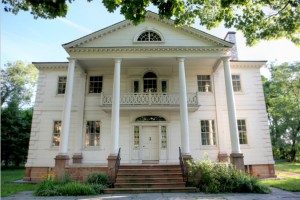 Just 2 blocks north of our building is the historic Morris-Jumel Mansion. General Washington used Morris-Jumel Mansion (MJM) as his headquarters during the fall of 1776. It was during this period that the General’s troops forced a British retreat at the Revolutionary War Battle of Harlem Heights
The house was built eleven years before the revolution, in 1765, by British Colonel Roger Morris and his American wife, Mary Philipse. The breezy hilltop location proved an ideal location for the family’s summer home. Known as Mount Morris, this northern Manhattan estate stretched from the Harlem to the Hudson Rivers and covered more than 130 acres. Because they were loyal to the crown, the Morrises were eventually forced to return to England.
During the war, the hilltop location of the Mansion was valued for more than its cool summer breezes. With views of the Harlem River, the Bronx, and Long Island Sound to the east, New York City and the harbor to the south, and the Hudson River and Jersey Palisades to the west, Mount Morris proved to be a strategic military headquarters. Shortly after the Battle of Harlem Heights, Washington and his troops left the Mansion and, for a time, it was occupied by British and Hessian forces.
President Washington returned to the Mansion on July 10, 1790, and dined with members of his cabinet. Guests at the table included two future Presidents of the United States: Vice President John Adams and Secretary of State Thomas Jefferson. Secretary of the Treasury Alexander Hamilton and Secretary of War Henry Knox also attended.
The Mansion is built in the Palladian style, with a second story balcony and a two-story front portico supported by classical columns. The two-story octagon at the rear of the house is believed to be the first of its kind anywhere in the colonies. The first floor of the 8,500 square foot house features rooms for family and social gatherings, and includes the parlor in which Madame Eliza Jumel married Aaron Burr in 1833. Across the hall stands the dining room where Washington likely entertained his guests in 1790. At the far end of the hall, the octagonal drawing room, or withdrawing room as it is properly known, provided a grand setting for social gatherings. Bedrooms on the second floor include those of George Washington, Eliza Jumel, and Aaron Burr. The basement houses the colonial-era kitchen and tells the story of domestic servitude at the Mansion. The room features the original hearth and a bee-hive oven as well as a collection of early American cooking utensils. Through architecture and a diverse collection of decorative arts objects, each room of the Morris-Jumel Mansion reveals a specific aspect of its colorful history from the 18th through the 19th centuries.
[This text is taken from the Morris-Jumel Mansion website.]
Coogan’s Bluff
Coogan’s Bluff, a large cliff extending northward from 155th Street in Manhattan, once was the site of the fabled Polo Grounds, the home of the New York Giants (baseball) for over 5 decades, and the first home of the New York Mets.
To the north of Highbridge park is a wooded area within which lies a landmark schist rock that pokes through the dirt called Coogan’s Bluff. It is named after James Coogan, Manhattan Borough President, who sold the land to New York Giants owner John T. Brush, who moved the Giants to the second Polo Grounds in 1891.
It sits atop a steep escarpment that descends 175 feet to the Harlem River Valley below. In 1891, John T. Brush (1845–1912), the Giants’ owner, bought the land for the stadium from James J. Coogan (1845–1915), a real estate merchant and Manhattan Borough President (1899–1901).
The Giants originally played in a polo field on 111th Street between Fifth and Sixth Avenues. Brush kept the name, Polo Grounds, when he moved the team to Coogan’s Bluff in 1891. In April 1911, the Polo Grounds, an elaborate wooden structure, burned to the ground. By October, the Giants were hosting the Philadelphia Athletics for the 1911 World Series in a rebuilt stadium of concrete and steel. The new Polo Grounds boasted box seats of Italian marble, ornamental American eagles on the balustrade, and blue and gold banners, 30 feet apart, flying from a cantilever roof. At the time, it was the premier Major League Baseball stadium.
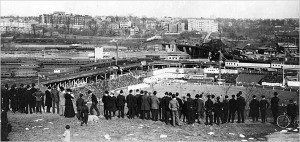 Baseball soon established itself as the quintessential American game, and the New York Giants made significant contributions to 20th century baseball lore. Mel Ott (1909–1958) and Willie Mays (b.1931) are thought to be among the finest players of all time; and the names of Christy Mathewson (1878–1925) and Carl Hubbell (1903–1988) are still mentioned whenever great pitchers are discussed. The Giants also provided baseball with one of its most dramatic moments: “the shot heard round the world.” In 1951, the Giants and their arch-rivals the Brooklyn Dodgers were in the ninth inning of the deciding game in a play-off to determine the National League pennant winner. With two outs left in the game, the Dodgers were ahead 4–2 when Bobby Thomson came to bat for the Giants and hit a 3‑run home run winning the game for the Giants, and making baseball history.
In 1957, the owner of the Giants, Horace Stoneham (1903–1990) broke many New York hearts when he announced that he was moving the Giants to San Francisco. The Polo Grounds remained for seven more years, serving as home to the New York Mets for the 1962 and 1963 seasons. In 1964 the stadium was demolished and now the Polo Grounds Towers, a housing project, occupies the site. All that is left of the original Polo Grounds is an old staircase on the side of the cliff that once led to the ticket booth.
Today, Coogan’s Bluff is part of Highbridge Park, which was assembled piecemeal between 1867 and the 1960s, with the bulk being acquired through condemnation from 1895 to 1901. The cliffside area from West 181st Street to Dyckman Street was acquired in 1902, and the parcel including Fort George Hill was acquired in 1928. The park extends from 155th Street in North Harlem to Dyckman Street in Washington Heights/Inwood. The Friends of Highbridge Park are involved in preserving the park’s history and the New York Restoration Project has cleaned the park and restored its trails.
[This text is part of Parks’ Historical Signs Project and can be found posted within the park.]
Paul Robeson Residence
 The Paul Robeson Residence, a National Historic Landmark, is located at 555 Edgecombe Avenue in New York City.
Paul Robeson (1898–1976) — actor, singer, civil rights advocate — lived in an apartment in this 13 story apartment building from 1939–1941, upon his return from living and performing in Europe.
Paul Robeson was a gifted student and athlete while attending Rutgers University in New Jersey. He was a brilliant Phi Beta Kappa student, two time All American football player (1917–1918), and won honors in debating and oratory. He graduated from Columbia Law School but gave up law to pursue a career in singing and acting. Robeson performed on Broadway, and is noted for his leading roles in Othello and Eugene O’Neill’s play, Emperor Jones, and his stunning rendition of the song “Ole Man River” in the musical Showboat. In 1934, he visited the Soviet Union, where he felt fully accepted as a black artist. During World War II, he entertained troops at the front and sang battle songs on the radio.
In 1937, Robeson wrote, “the artist must elect to fight for freedom or for slavery. I have made my choice. I have no alternative.” He continued this fight for freedom, both political and artistic, until his death in 1976.
Despite his war efforts, he was labeled “subversive” by McCarthyites, who were wary of his earlier trip to the Soviet Union, his support of the 1947 St. Louis picketing against segregation of black actors and a Panama effort to organize the mostly-black Panamanian workers. Robeson began receiving death threats from the Ku Klux Klan while campaigning for the Progressive Party candidate in the 1948 presidential election. When he publicly opposed the Cold War, even the national secretary of the NAACP questioned his loyalty as an American. Connecticut state officials also went to court to prevent him from visiting his family home in Enfield. Undaunted, Robeson formally denounced the action and on August 27, 1949, traveled to Peekskill, New York, to sing before a group of African American and Jewish trade unionists. A KKK-led riot canceled the concert but Robeson returned the following week with 25,000 supporters. A “human wall” protected Robeson while he sang, though afterwards many of the concert goers were ambushed and beaten while local police and state troopers stood by.
In March 1950, NBC barred Robeson from appearing on a television show with Eleanor Roosevelt. Concert halls closed their doors to him, and his records began to disappear from stores. After eight years, an international outcry, and the Supreme Court’s reversal of the same situation for the artist Rockwell Kent in 1958, Robeson won.